Do Grill Marks Actually Add Flavor, or Are They Just for Show? The Honest Answer
Quick Answer: Grill marks themselves add minimal extra flavor beyond what even, thorough contact with the grates already provides — the visual crosshatch pattern often comes at the cost of less total surface caramelization, which is where the actual flavor comes from.
The crosshatch sear looks like a restaurant photo. But chasing those exact marks can quietly work against the very browning that creates real flavor.

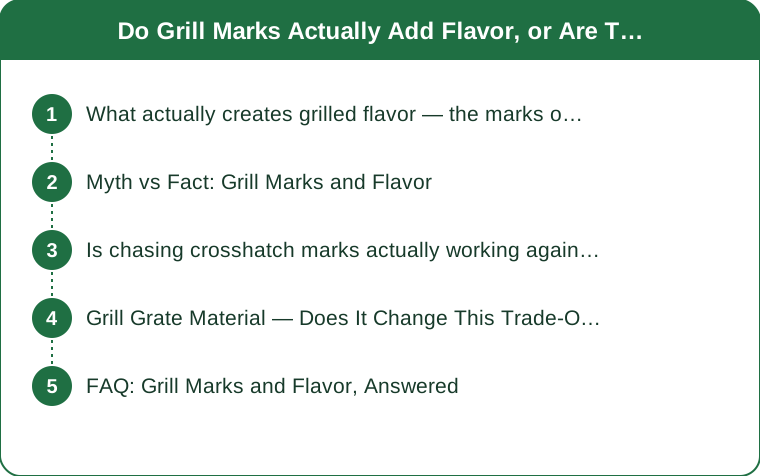
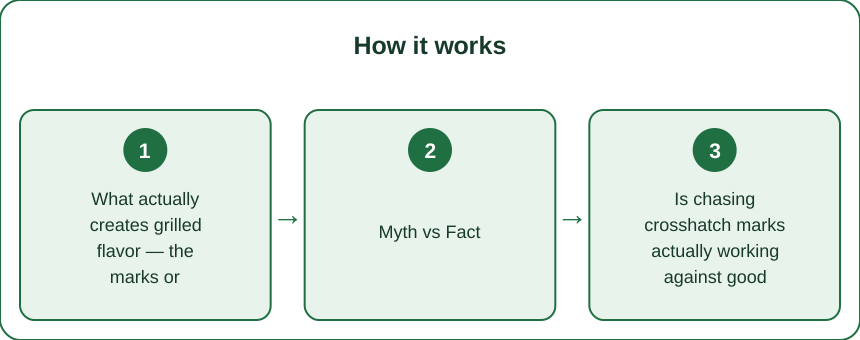
What actually creates grilled flavor — the marks or something else?
Flavor comes primarily from the Maillard reaction, the browning that happens across the entire surface in contact with heat, not from the specific pattern of the marks themselves. A steak with full, even browning across its whole surface but no crosshatch pattern will often taste just as good, sometimes better, than one with picture-perfect marks.
Myth vs Fact: Grill Marks and Flavor
Myth: Dark grill marks mean more concentrated flavor at that spot. Fact: The marked areas are simply where direct grate contact caused browning — the unmarked areas between marks are often less browned and, unfairly, lower in flavor, not the other way around.
Myth: Rotating for crosshatch marks doesn’t affect cook time. Fact: The extra handling and repositioning needed for a clean crosshatch can mean less total surface time in contact with heat, resulting in less overall browning.
Myth: All grill grate types produce the same marks and flavor. Fact: Cast iron grates sear more intensely and evenly than thin stainless rod grates, which affects both mark clarity and actual flavor development.

Is chasing crosshatch marks actually working against good grilling?
For some cooks, yes — the fussing required to get a clean 45-degree rotation partway through cooking can interrupt the steady, undisturbed contact that produces the most even browning. Leaving the food alone longer for full surface contact often produces better overall flavor than the timed rotation crosshatch marks require.
Grill Grate Material — Does It Change This Trade-Off?
Cast iron and heavier grates hold and transfer heat more evenly, producing both better crosshatch definition and better overall browning simultaneously — the trade-off between marks and total flavor is less pronounced on these grates than on thin, quick-heating stainless rod grates common on many gas grills.
FAQ: Grill Marks and Flavor, Answered
Is it worth avoiding crosshatch marks entirely for better flavor?
Not necessarily — a light rotation for marks doesn’t meaningfully hurt flavor; the concern is more about excessive fussing and moving food too often.
Do grill marks affect food safety or doneness accuracy?
No — doneness should always be checked by internal temperature, not by the appearance of grill marks, which say nothing about internal cooking.
Does resting the meat matter more than the marks for final flavor?
Yes — proper resting time after grilling affects juiciness and perceived flavor more than the presence or pattern of grill marks.
TL;DR:
- Flavor comes from full-surface browning (the Maillard reaction), not the crosshatch pattern specifically
- Excessive rotating for perfect marks can reduce total surface contact time and browning
- Cast iron and heavier grates produce good marks and good browning simultaneously
- Doneness should always be checked by temperature, never by how the marks look
Grill marks are a nice bonus, not the flavor source — even, undisturbed contact with the grate is what actually does the work.
Keep Reading
This article is for general informational purposes only and is not medical advice. Always consult a qualified health professional for guidance specific to you.