Why Your Grill Runs Cooler in Autumn and How to Adjust For It
Quick Answer: A grill loses heat to cooler surrounding air faster than most people expect, so the same setting produces a lower cooking temperature in autumn — often 25 to 50°F lower on a gas grill and more on charcoal. Preheat longer, keep the lid closed more, and cook by internal temperature rather than by time. Wind matters more than air temperature, and a windy 60°F day is harder on a grill than a still 45°F one.
You grilled this exact chicken in midsummer and it took eighteen minutes. The first genuinely cool evening of the season arrives and the same chicken at the same setting is still pink at twenty-six.
Nothing is wrong with the grill. The physics of the situation changed while your habits did not.
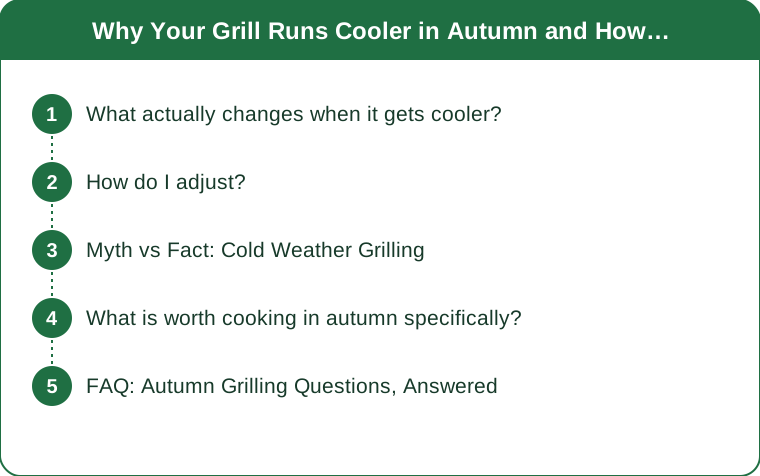
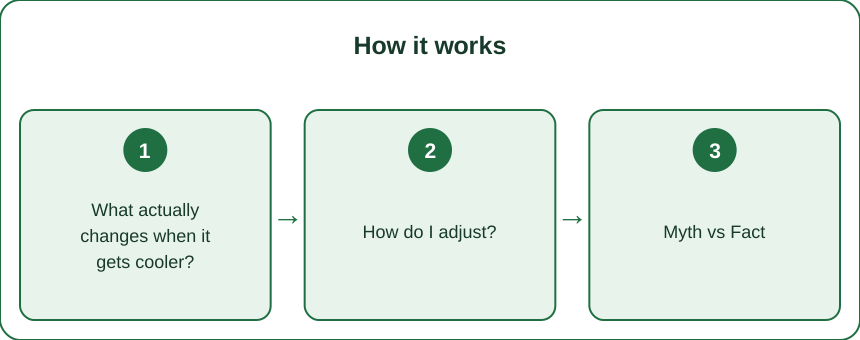
What actually changes when it gets cooler?
Three things, in order of impact.
Heat loss through the grill body accelerates. A grill is a metal box radiating heat into the air around it. The bigger the difference between inside and outside, the faster heat escapes. At 45°F ambient with a 400°F grill, that gradient is roughly 30% steeper than at 85°F.
Wind is the real problem, not temperature. Moving air strips heat from the grill body continuously. A 15mph wind can cost you more cooking temperature than a 30°F drop in still air, which is why some autumn days feel disproportionately difficult.
Your food starts colder. Ingredients that sat on a counter in a 78°F kitchen now sit in a 66°F one, and anything coming straight from a fridge into cold air has further to travel. Cold food in a cooler grill compounds.
What does not change: the temperature your food needs to reach. 165°F for chicken is 165°F in January, which is why time-based recipes stop working and thermometer-based ones keep working perfectly.
How do I adjust?
Preheat longer — 15 minutes instead of 10. The grates and the metal body need to actually reach temperature, not just the air inside. Grates that are not fully heated are the direct cause of sticking, which is why food sticks more in autumn.
Keep the lid closed. Every lid lift costs meaningful heat and it recovers more slowly in cool air. Check less often, not more, even though the slower cooking makes you want to do the opposite.
Expect 20 to 30% longer cook times as a rough starting point, more if it is windy.
Turn the burners up one notch from your summer setting to land at the same grate temperature. Trust your grill thermometer over your knob position — the knob is an input and the thermometer reports the actual result.
Position the grill out of the wind, but never against a wall or under an overhang. Three feet of clearance is a minimum for safety and airflow both.
Use two-zone cooking more. A hot side and a cooler side gives you somewhere to move food that is browning faster than it is cooking through — a mismatch that gets worse in autumn.
Charcoal specifics: use more fuel than in summer, expect a longer chimney time, and keep the vents more open. Charcoal loses efficiency in cold and wind faster than gas does because there is no burner compensating.
Myth vs Fact: Cold Weather Grilling
Myth: You cannot grill below 50°F. Fact: You can grill at any temperature people are willing to stand outside in. It takes longer and uses more fuel, and that is the whole difference.
Myth: Cold weather ruins the flavor. Fact: Flavor comes from the Maillard reaction and smoke, both of which depend on grate temperature rather than air temperature. A properly preheated grill produces identical results in October and July.
Myth: A grill cover helps while cooking. Fact: Never cook with a fabric cover on — it is a fire risk. A wind screen positioned safely away from the grill is the actual solution.
Myth: Propane does not work in the cold. Fact: Propane vaporizes down to around -44°F, so autumn is not remotely close to an issue. What is true is that tank pressure reads lower when cold, which makes a partly full tank behave like an emptier one. Keep a spare.
Myth: You should flip more often to speed things up. Fact: Flipping releases heat and interrupts crust formation. Fewer flips with the lid down cooks faster in cold weather, not slower.
What is worth cooking in autumn specifically?
Thicker cuts benefit from the conditions. A slower, cooler grill is closer to a roasting environment, which suits a bone-in chicken thigh, a pork shoulder, or a thick steak better than it suits a thin fillet.
Root vegetables come into their own. Squash, sweet potato, carrots, and onions all grill well now and want the longer, gentler cooking that cool weather naturally produces. Cut them thinner than you would in the oven and use the cooler zone.
Reverse searing gets easier. Cook low on the indirect side to about 10 to 15°F below your target, then sear hot at the end. Autumn’s slower indirect zone is well suited to this and it produces a more evenly cooked interior.
Thin, fast items get harder. Fish fillets, thin burgers, and delicate vegetables suffer most from an underheated grate. Preheat properly or cook these indoors — this is the one category where autumn genuinely disadvantages you.
Keep a thermometer in your pocket, not in a drawer. An instant-read thermometer is the single tool that makes cold-weather grilling reliable, because it replaces every time estimate that just stopped being accurate.
FAQ: Autumn Grilling Questions, Answered
How much longer will things actually take?
Plan on 20 to 30% longer in still, cool weather and up to 50% longer in wind. Start checking internal temperature at your normal summer time and expect to keep going.
Should I move the grill closer to the house for warmth?
No. Keep at least three feet from any structure and never grill under an overhang or in a garage, open door or not. Carbon monoxide and fire risk are both real and neither is worth a few degrees.
Does my grill use more gas in the cold?
Yes, noticeably — longer preheats, higher settings, and longer cooks all add up. A tank that lasted six summer cookouts may last four in autumn.
Do I still need to clean the grates as often?
More, if anything. Preheating that stops short leaves more residue behind, and residue is what causes the sticking that gets blamed on the weather.
TL;DR: The grill is fine. The heat gradient changed and your timings did not.
- Cooler air pulls heat out faster — expect 25 to 50°F lower at the same setting.
- Wind costs more than temperature. A windy 60°F day is harder than a still 45°F one.
- Preheat 15 minutes, not 10. Cold grates are why food sticks in autumn.
- Cook to internal temperature, never to time. Every time-based recipe just became wrong.
- Keep the lid down and flip less. The instinct to check more often works against you.
- Thick cuts and root vegetables suit the conditions; thin fish and burgers suffer most.
Put an instant-read thermometer by the back door. It is the one purchase that makes every autumn cook predictable again.
Keep Reading
This article is for general informational purposes only and is not medical advice. Always consult a qualified health professional for guidance specific to you.